
We’ve all said it.
“I’ll start Monday.”
“I’ll eat better next week.”
“I’ll get back to the gym when things calm down.”
“I just need more willpower.”
But here’s the truth: you don’t need a perfect Monday, more willpower, or a completely different life to start taking better care of yourself.
Real health changes happen when we learn how to make small, realistic changes that actually fit into the life we are already living.
At Caruso Physical Therapy & Nutrition, we believe nutrition is about so much more than handing someone a list of foods they can and cannot eat. Registered Dietitians help people understand why certain behaviors are happening and, more importantly, how to create changes that are sustainable.
Because knowing what to do and actually being able to do it are two very different things.
Why Healthy Habits Are So Hard to Change
We often think of behaviors as the problem.
“I eat too much at night.”
“I never eat breakfast.”
“I keep ordering takeout.”
“I’m not exercising enough.”
“I can’t stop snacking.”
But a behavior is often a symptom of something else.
Maybe you’re exhausted.
Maybe you’re skipping meals all day and becoming ravenous at night.
Maybe your schedule is completely packed.
Maybe you don’t have food prepared.
Maybe you’re using food for comfort.
Maybe the goal you chose isn’t actually realistic for your current life.
Instead of simply saying, “Stop doing that,” sustainable behavior change asks a different question:
“What is getting in the way?”
That is where working with a Registered Dietitian can be incredibly helpful.
Rather than giving you a generic set of nutrition rules, an RDN can help you figure out how nutrition, movement, routines, stress, and your individual needs all fit together.
You Don’t Need More Willpower
One of the biggest misconceptions about changing your health habits is that you simply need more willpower.
But sustainable change isn’t about white-knuckling your way through a diet.
Think about it this way:
Importance + confidence = your ability to take action.
You might know that something is important, but if you don’t feel confident that you can actually accomplish it, you’re much less likely to follow through.
For example, you might decide:
“I’m going to exercise six days a week, cook every meal at home, completely eliminate sugar, drink a gallon of water, and lose 20 pounds.”
Sounds motivating on Sunday.
By Wednesday?
Probably not so much.
Instead, start smaller.
Maybe your first goal is:
“I will walk for 20 minutes after dinner on Monday, Wednesday, and Friday.”
That’s specific.
That’s measurable.
And, most importantly, it has a much better chance of fitting into your actual life.
Start Where You Are — Not Where You Think You Should Be
You don’t need to wait until life slows down.
Because life rarely does.
There will always be work.
There will always be birthdays.
There will always be vacations, holidays, busy weeks, sick kids, deadlines, unexpected appointments, and nights when dinner doesn’t go according to plan.
Waiting for the “perfect time” is one of the easiest ways to never start.
Instead, ask yourself:
What is one small thing I can do right now?
Maybe it’s adding a protein source to breakfast.
Maybe it’s keeping fruit available at home.
Maybe it’s adding a vegetable to dinner.
Maybe it’s drinking more water.
Maybe it’s scheduling your first appointment with a Registered Dietitian.
Maybe it’s going to bed 30 minutes earlier.
Small changes may not feel dramatic—but they add up.
Set Goals That Are Actually SMART
A good health goal shouldn’t just sound inspiring. It should be something you can actually execute.
When creating a goal, ask yourself:
- What exactly am I going to do?
- How often will I do it?
- When and where will I do it?
- How will I keep track of it?
- How confident am I that I can accomplish it?
- What would make me more confident?
- When will I reassess my progress?
For example, instead of:
“I want to eat healthier.”
Try:
“I will eat breakfast at least five mornings this week and include a source of protein and fiber.”
That’s a goal you can actually measure.
And here’s something important:
Your goal should be challenging—but realistic.
If you rate your confidence at a 4 out of 10, the goal may need to be adjusted.
That isn’t failure.
That’s good goal-setting.
Progress Over Perfection
One of our favorite messages at Caruso is simple:
Aim for progress, not perfection.
You are going to have meals that aren’t perfectly balanced.
You are going to miss workouts.
You are going to eat dessert.
You are going to order takeout.
You may have a week where everything seems to fall apart.
That doesn’t erase your progress.
Think about your health journey like a road trip.
If you get a flat tire, you don’t decide that the entire trip is ruined.
You fix the tire and keep going.
The destination hasn’t changed.
You may simply need to change how you get there.
Let’s Talk About Nutrition Myths
There is no shortage of nutrition advice on the internet.
One person says carbohydrates are bad.
Another says you should only eat protein.
Someone else says you need to eliminate dairy.
Another person tells you that you shouldn’t eat after a certain time.
And suddenly, eating feels incredibly complicated.
The truth?
Your body needs carbohydrates, protein, fat, fiber, vitamins, minerals, and adequate energy.
There is no single food that will magically make you healthy—and no single food that will ruin your health.
Your body needs carbohydrates.
Carbohydrates provide energy and are an important part of a balanced eating pattern. Whole grains and other fiber-rich carbohydrate sources can be especially beneficial.
Think:
- Oatmeal
- Whole wheat bread
- Whole wheat pasta
- Brown rice
- Quinoa
- Beans
- Chickpeas
- Lentils
- Potatoes
- Edamame
- Fruits and vegetables
Instead of asking, “How do I cut carbs?”
Try asking:
“How can I choose more fiber-rich carbohydrates?”
That’s a much more sustainable question.
Protein Matters—but More Isn’t Always Better
Protein is important for many functions throughout the body, and protein-rich foods can be incorporated into meals and snacks throughout the day.
Good options can include:
- Eggs
- Poultry
- Seafood
- Lean meats
- Greek yogurt and other dairy foods
- Beans and lentils
- Soy foods
- Nuts and seeds
But here’s the catch:
More protein isn’t automatically better.
Protein needs vary from person to person based on factors such as body size, activity level, age, health status, and individual goals.
Instead of letting social media determine how much protein you need, talk with a Registered Dietitian or healthcare provider about what is appropriate for you.
Fiber Is a Big Part of Healthy Eating
Fiber is another important piece of the nutrition puzzle.
Fiber-rich foods can include whole grains, beans, lentils, fruits, vegetables, nuts, and seeds.
A general target is around 25–38 grams of fiber per day, although individual needs can vary.
One of the easiest ways to increase fiber?
Don’t completely overhaul your diet. Add to what you’re already eating.
Add berries to breakfast.
Choose a whole-grain bread.
Add beans to your salad.
Mix ground flaxseed into oatmeal or a smoothie.
Add vegetables to lunch or dinner.
Small additions can make a big difference.
What About Fats?
Fat is not the enemy either.
Healthy dietary patterns can include foods such as:
- Avocado
- Nuts
- Seeds
- Olives
- Seafood rich in omega-3 fats
- Eggs
- Dairy
- Olive oil
Rather than fearing fat, focus on variety, balance, and the overall quality of your eating pattern.
And remember: your body needs dietary fat.
Stop Labeling Foods “Good” or “Bad”
This might be one of the most important shifts you can make in your relationship with food.
When we label foods as “good” or “bad,” eating can quickly become a test of whether we’ve been “good” or “failed.”
Instead, try using neutral language.
Rather than:
“I was bad today.”
Try:
“That meal didn’t make me feel as satisfied as I wanted. What could I do differently next time?”
Rather than:
“I can’t have that.”
Try:
“I can choose that food, and I can decide how it fits into my overall eating pattern.”
Health isn’t determined by one meal.
It’s determined by what we do consistently over time.
A Healthy Relationship With Food Goes Beyond Calories
A healthy relationship with food isn’t simply about eating the “right” number of calories.
It’s also about:
- Being able to enjoy food
- Eating without guilt
- Recognizing hunger and fullness
- Understanding food as fuel
- Including variety
- Avoiding unnecessary restriction
- Moving your body because you want to feel strong
- Understanding that different bodies have different needs
- Letting food be part of your life—not the thing that controls your life
At Caruso, we believe all foods can fit.
That doesn’t mean every food needs to be eaten all the time.
It means there is room for flexibility.
There is room for birthdays.
There is room for pizza.
There is room for vegetables.
There is room for dessert.
There is room for nutrition.
And there is room for enjoyment.
Your Health Is About More Than a Number on the Scale
Your health isn’t defined solely by your weight.
It’s about how you feel.
How you function.
How you fuel your body.
How you move.
How you sleep.
How you manage stress.
How you relate to food.
And what your body is capable of doing.
We want to move away from the idea that health is about making your body smaller at all costs.
Instead, let’s focus on what your body can DO, what it is CAPABLE of, and how nutrition can help you live the life you want.
So…Where Do You Start?
Don’t wait until Monday.
Don’t wait until January.
Don’t wait until work slows down.
Don’t wait until you have more motivation.
Start with one thing.
Ask yourself:
What is one change that would make my health a little better this week?
Then make a plan.
Make it specific.
Make it realistic.
And give yourself permission to adjust it when life happens.
Because healthy habits aren’t created through perfection.
They’re created through practice.
And if you aren’t sure where to start, that’s exactly what Registered Dietitians are here for.
Ready to Make Nutrition Work for YOUR Life?
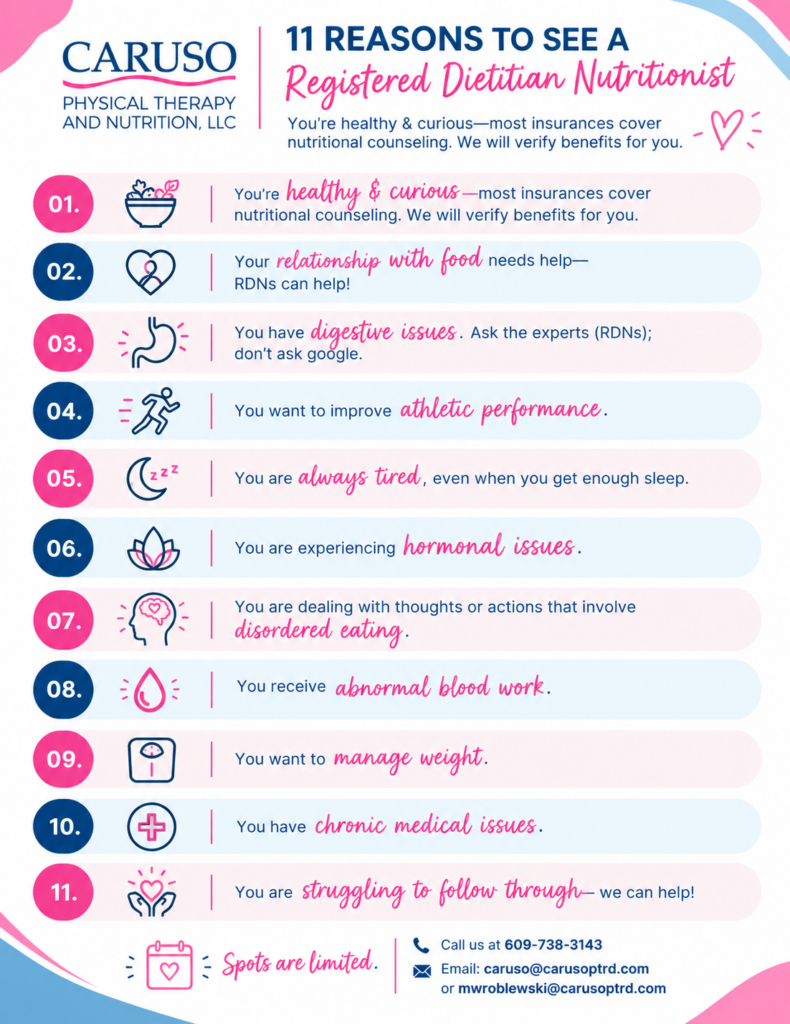
At Caruso Physical Therapy & Nutrition, we believe nutrition counseling should be individualized, practical, and rooted in your real life—not a one-size-fits-all diet.
Our Registered Dietitians work with individuals and families across a variety of nutrition needs, including eating disorders, gastrointestinal conditions, diabetes, PCOS, weight management, sports nutrition, hormonal health and menopause, nutrition across the lifespan, and prenatal and postpartum nutrition.
You don’t need another restrictive diet.
You don’t need another list of foods you “can’t” eat.
You need a plan that makes sense for you.
Don’t wait for Monday. Let’s get started.
📞 609-738-3143
📧 caruso@carusoptrd.com
🌐 www.carusoptrd.com